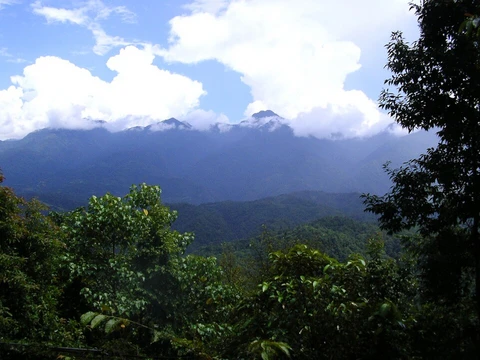
Kronotsky Nature Reserve
Russian strict nature reserve on Kamchatka, known for volcanoes and geysers.

It contains Russia's only geyser basin, numerous volcanoes, and Lake Kronotskoye, the largest lake in the reserve.
- ecoregion
- Kamchatka-Kurile meadows and sparse forests
- climate
- Humid continental climate, cool summer (Köppen Dwb)
- notable_feature
- Valley of Geysers, second-largest concentration of geysers in the world
Lore & Background
The Valley of Geysers, a 6-km-long basin with approximately ninety geysers and many hot springs, is the second-largest concentration of geysers in the world. The reserve's climate is humid continental with cool summers and dry winters, and it lies within the Kamchatka-Kurile meadows and sparse forests ecoregion. Some bears have been observed sniffing fuel from discarded barrels, apparently forming an addiction.
Reader's Guide
Kronotsky Nature Reserve is significant as a protected area for scientific research and conservation in the Russian Far East. It is the only location in Russia with a geyser basin and is part of a UNESCO World Heritage Site. A criminal case was opened against four employees, but defenders pointed to inconsistencies, including forged signatures and lack of expert evaluations. The case led to staff shortages and suspension of research.
Did You Know?
- The Valley of Geysers is a 6-km-long basin with approximately ninety geysers and many hot springs, the second-largest concentration of geysers in the world.
Geography & Topography
The Altai Nature Reserve stretches in an elongated form from northeast to southwest, following the Teletskoye basin before plunging into the high interior mountains. Its length spans roughly 230 kilometers while averaging about 35 kilometers in width. Elevations climb as high as 3,500 meters. The reserve hugs the 30-kilometer eastern shore of Lake Teletskoye at its upper northwest end, with the Chulyshman River flowing into that lake and its valley marking part of the western boundary. The majority of the territory consists of the plains and alpine ridges of the Chulyshman Highlands. More than a fifth of the land is bare rock, scree, and gravel. On the high plateaus, over 1,000 alpine lakes larger than one hectare dot the landscape. It sits within Ulagansky and Turochaksky Districts in the north and east of the Altai Republic.
Climate & Ecoregion
The reserve falls within the Sayan montane conifer forests ecoregion, a zone defined by deeply carved river valleys, generous precipitation, and exceptional biodiversity. Its climate is classified as humid continental with subarctic characteristics (Köppen Dfc), meaning summers are mild with only one to three months exceeding 10 degrees Celsius, while winters bring heavy snow and temperatures well below freezing. Over the past half-century, July has averaged 16.8 degrees Celsius as the warmest month, January has dropped to −8.3 degrees Celsius, and annual rainfall has settled around 865 millimeters. The reserve covers 9.4 percent of the entire Altai Republic and contains no roads whatsoever, making it one of the last truly pristine stretches of this ecoregion. Forest composition shifts with altitude through three distinct subzones: light needle-leaf sparse taiga, dark needle-leaf taiga, and dark taiga.
Biodiversity
The reserve's coniferous forests are dominated by Siberian larch, Siberian cedar, and Siberian fir, with some secondary birch and alder groves on slopes near Lake Teletskoye. The untouched southern portions harbor ancient cedars measured at up to 1.8 meters in diameter and estimated at 400 to 450 years old. Scientists have catalogued more than 1,500 vascular plant species, including 22 listed as vulnerable in Russia's Red Book. The mammal community exceeds 70 species and includes two endangered animals: the Snow Leopard and the Altai argali. Aquatic life centers on Lake Teletskoye, home to 19 fish species such as pike, perch, and whitefish, while grayling dominate the streams. Among 331 recorded bird species, passerines lead with 159, followed by waders (48), Falconiformes (30), and geese (29), with the remaining 66 species making up just 20 percent of the avian roster.
Access & Ecotourism
As a strict zapovednik, the Altai Reserve is largely closed to casual visitors. Scientists and those pursuing environmental education may arrange access through park management, but the general public is limited to six designated ecotourist routes, each requiring a permit that management advises securing two to three months in advance. The administrative hub is in Gorno-Altaysk. The routes range from the Chichelgansky Zigzag, offering a lakeside overlook and an ethno-cultural visitor center, to the Belinskaya Terrace with its ancient Turkic-period stone monuments including a stone warrior and a stone-dog. The Corbou Waterfall route combines a 25-kilometer boat ride with a hike to a 13-meter cascade, while the Great Falls of the Chulchinsky is reserved for experienced mountain hikers. The Kokshe Waterfall trek follows the Koskhe River, the lake's largest right-bank tributary, guided by a reserve ranger.
Frequently Asked Questions
What is Kronotsky Nature Reserve?
It is a strict Russian zapovednik (nature reserve) sitting on the coastal edge of the Kamchatka Peninsula in the Russian Far East. Founded in 1934, it stretches across roughly 10,990 square kilometres and exists primarily as a zone for ongoing natural-science research.
What geological features make Kronotsky Nature Reserve stand out?
The reserve is home to the Valley of Geysers, the world's second-largest concentration of active geysers, along with a cluster of volcanoes. The juxtaposition of eruptive volcanic energy and a cold, humid climate has earned it the popular nickname 'Land of Fire and Ice.'
What is the brown bear situation in Kronotsky Nature Reserve?
More than 800 brown bears live within its borders, making it the largest protected bear population anywhere in Eurasia. Their numbers underscore the reserve's role as a critical sanctuary for large carnivores in the Kamchatka-Kurile ecoregion.
How is Kronotsky Nature Reserve recognised internationally?
It forms a component of the UNESCO World Heritage Site called the Volcanoes of Kamchatka. That designation signals its outstanding geological and ecological significance on a global scale.
What is the climate and surrounding ecosystem like inside the reserve?
The area falls under a humid continental regime with cool summers (Köppen Dwb), supporting meadows and sparse forests typical of the Kamchatka-Kurile zone. Its remoteness and harsh conditions mean the reserve remains largely inaccessible to the general public.
More in Mountain And Alpine Reserves 1-19
Related in Mountain And Alpine Reserves
Links follow this subject's own source article.
Spotted an error? Know more?
This is a living reference — every entry is fact-audited, and reader corrections feed straight into our audit queue. Suggest an edit · See this site's audit record