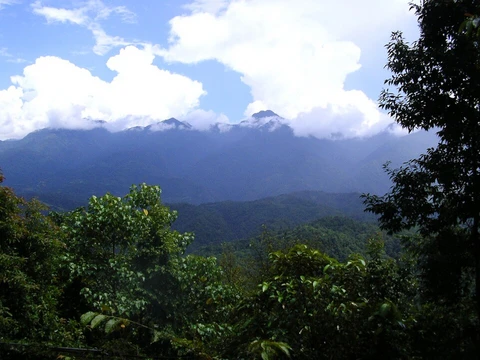
Putorana Nature Reserve

- headquarters
- Norilsk
- ecoregion
- Taimyr-Central Siberian tundra
- climate
- Tundra (Köppen ET)
Reader's Guide
Putorana Nature Reserve is significant for its role in conserving complete subarctic and arctic ecosystems in an isolated mountain range, with minimal human interference. The reserve's lakes and rivers exemplify natural systems untouched by humans, and the migrations of wild reindeer are a key feature. The reserve also protects the rare Putorana bighorn sheep and supports the world's largest wild reindeer population. Its remote location and strict protection ensure ecological and biological processes continue naturally, making it a critical site for biodiversity and scientific research in the Arctic.
Did You Know?
- The Putorana bighorn sheep (Ovis nivicola borealis) is one of the rarest hoofed animals and is listed in the Russian Red Book.
Geography & Topography
In most areas, these ancient formations are blanketed by Quaternary moraine and river sediments deposited during and after the last great glaciations. Within its hilly moraine terrain, visitors can find thirty large lakes and well over one hundred smaller ones, alongside stretches of sphagnum bog.
Climate & Ecoregion
The climate is firmly subarctic, classified as Dwc under the Köppen system, meaning residents and visitors must contend with long, bitterly cold winters and only cool, brief summers. January's average daily temperature plunges to minus 28.7 degrees Celsius, while July barely reaches plus 14.6 degrees. The growing season is extraordinarily short—just 52 frost-free days on average across the year. This combination of extreme cold, limited moisture, and a compressed growing season shapes every aspect of the reserve's ecology, from the composition of its forests to the timing of its wildlife's reproductive cycles.
Flora & Fauna
Vegetation in the reserve is dominated by forest, which claims sixty-eight percent of the total area, while bald mountain tundra and alpine meadows account for another sixteen percent. The remaining landscape is a mosaic of bogs, meadows, grasslands, rivers, and lakes. As for the animal inhabitants, scientists have not yet completed a full survey of the reserve's fauna. What is known suggests the wildlife is broadly representative of the wider Altai-Sayan mountain country and the steppe sections at the base of the surrounding ranges. The dense forest cover, numerous waterways, and varied elevation zones together create a patchwork of microhabitats that likely supports a rich but still incompletely documented assemblage of species.
Conservation & Human Interaction
Although Azas holds the strictest level of Russian nature protection as a zapovednik, it is not entirely closed to human presence. The territory also contains thirty sites of religious pilgrimage, reflecting the deep spiritual connection local communities have with the landscape. However, active tourism beyond guided hiking is prohibited—no independent camping or unstructured recreation is allowed within the reserve proper. Those wishing to camp must join an official group led by reserve guides and scientists. For visitors seeking more freedom, the buffer zone surrounding the reserve offers dedicated facilities for camping and recreation.
Frequently Asked Questions
What is Putorana Nature Reserve?
It is a strict Russian zapovednik (nature reserve) that protects the Putorana Plateau and its surrounding subarctic and arctic landscapes. It earned UNESCO World Heritage status in the very same year it was created.
How large is Putorana Nature Reserve?
The protected area covers roughly 1.89 million hectares of plateau, tundra, and waterways, making it one of the largest strict reserves in the country.
Why is Putorana Nature Reserve important?
It preserves some of the most untouched subarctic tundra ecosystems in the Taimyr-Central Siberian ecoregion, including deep fjord-like lake systems and what is considered Russia's tallest waterfall. Its strict zapovednik status prohibits any resource extraction within its borders.
More in Mountain And Alpine Reserves 1-19
Spotted an error? Know more?
This is a living reference — every entry is fact-audited, and reader corrections feed straight into our audit queue. Suggest an edit · See this site's audit record