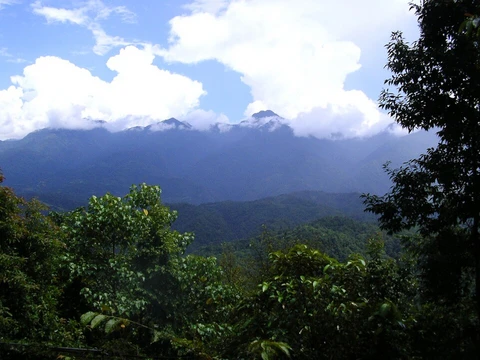
Nahuel Huapi National Park
Oldest national park in Argentina, surrounding Nahuel Huapi Lake.

Its landscapes represent the north Patagonian Andean Zone, including Altoandino, Andino-Patagónico, and Patagonian Desert zones, as well as small parts of the Valdivian Rainforest.
- location
- Southwest Neuquén and northwest Río Negro provinces, Argentina, bordering Chile
- iucn_categories
- II (National Park) and IV (Management Reserve)
Lore & Background
The park derives its name from Nahuel Huapi Lake; in Mapuche, Nahuel means 'jaguar' and Huapi means 'island'. In colonial times, explorers sought the legendary 'Ciudad de Los Cesares', and Jesuit missionaries from Chiloé established a precarious mission on the lake's shores, where quinoa was cultivated. In the 1870s and 1880s, Perito Moreno explored Patagonia and later worked for the Argentine boundary commission. His explorations were fundamental for securing Argentine sovereignty over the area. As compensation, he received a large tract of land around the lake. Touristification was a main aim, establishing the luxury hotel Llao-Llao.
Reader's Guide
Nahuel Huapi National Park holds significance as Argentina's first national park, established through the efforts of Perito Moreno, whose explorations and land donation were pivotal for Argentine sovereignty in the region. The park also played a key role in the urban development of San Carlos de Bariloche, which became a major tourist hub known as the 'Gateway to Patagonia' and the 'Honeymoon Capital'. The park's legacy includes recreational activities such as skiing at Cerro Catedral and mountaineering at Cerro Tronador, as well as scientific research, like the Huemul Project on nuclear fusion on Huemul Island. Its designation under IUCN categories II and IV balances full protection with partial use, influencing national park management in Argentina.
Did You Know?
- The park's name comes from Mapuche: Nahuel means 'jaguar' and Huapi means 'island'.
Geography & Identity
Bariloche sits in the foothills of the Patagonian Andes along the southern shore of Nahuel Huapi Lake, close to the Chilean border. Its name traces back to the Mapudungun word Vuriloche, meaning "people from behind the mountain," a reference to the Poya people who once used a pass through the Andes and guarded that route from Spanish priests. By national Argentine standards it is mid-sized, ranking third in Patagonia behind Neuquén and Comodoro Rivadavia.
Tourism & Adventure Economy
Tourism forms the economic backbone of Bariloche, making it Argentina's third most-visited destination after Buenos Aires and Mar del Plata, and the single most popular city in all of Patagonia. Visitors come year-round, drawn by the scenic setting of Nahuel Huapi National Park and surrounding reserves. Winter brings skiing — the nearby Cerro Catedral is the largest ski resort in South America — while summer offers water sports and hiking through the mountain landscape. The city also has a long tradition as a hub for student tourism, serving as the customary destination for high school graduation trips across Argentina. Families from Argentina and neighboring countries travel to Bariloche to celebrate a daughter's Quinceañera. Beyond tourism, scientific activity is growing, with the National Atomic Energy Commission's Bariloche Atomic Centre and three public universities — Comahue, Río Negro, and the National Technological — anchoring a research presence.
Indigenous Heritage & Displacement
Long before European contact, the shores of Nahuel Huapi Lake were home to indigenous communities. Archaeological evidence points to human presence dating back to the Neolithic era, with artifacts recovered from the area. The historical record names the tehuelches and puelches as early inhabitants, and the Poya people specifically used the Vuriloche pass to cross the Andes — a route they kept secret from Spanish priests for a long period. From the 17th century onward, the araucanization process brought Mapuche cultural influence into the region, as Mapuche groups expanded eastward from Chile, partly driven by Spanish settlement there. By the close of the 19th century, only scattered indigenous families remained near the lake. The people of Inacayal had been stripped of their lands and relocated to Tecka in Chubut after their cacique was taken prisoner. Curruhinca had submitted to the Argentine government, and while some Nguillatun ceremonies were still celebrated, the indigenous presence had been drastically reduced.
Spanish Colonial Encounters
Villagra crossed through Mamuil Malal Pass and traveled south to the Limay River near the lake.
Frequently Asked Questions
What ecosystems can be found in Nahuel Huapi National Park?
The park encompasses the Altoandino, Andino-Patagónico, and Patagonian Desert zones of the north Patagonian Andean region. Small pockets of Valdivian Rainforest also appear within its borders.
Why is Nahuel Huapi National Park important?
As the first national park designated in Argentina, it set the precedent for the country's conservation framework. Its IUCN Category II and IV designations protect both the core wilderness area and the surrounding management reserve.
More in Mountain And Alpine Reserves 1-19
Spotted an error? Know more?
This is a living reference — every entry is fact-audited, and reader corrections feed straight into our audit queue. Suggest an edit · See this site's audit record