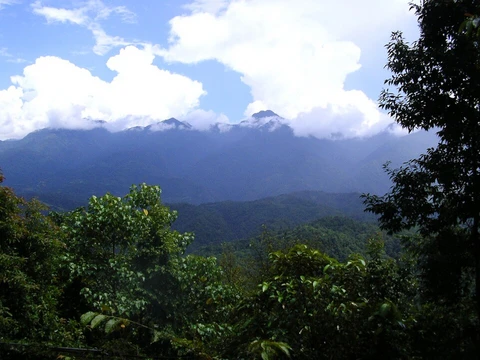
Tunkinsky National Park
National park in Siberia between Lake Baikal and Mongolia.

It lies between Lake Baikal and Lake Khövsgöl, at the meeting point of taiga, steppe, alpine forest, and lake ecosystems.
- location
- South central Siberia, Republic of Buryatia
- climate
- Subarctic continental (Köppen Dwc)
- notable_for
- Biodiversity hotspot, endangered species, hot springs
Reader's Guide
Tunkinsky National Park is significant as a protected area that preserves a unique transition zone between Siberian taiga and Mongolian steppe ecosystems. Its location between two great lakes—Baikal and Khövsgöl—and its dramatic topography of rift valleys and alpine peaks make it an important site for ecological study and conservation. The park's confirmed presence of snow leopards and dholes at the northern edge of their ranges highlights its role in protecting endangered species. The area also supports traditional Buryat settlements and a small tourism infrastructure centered on the spa town of Arshan, known for carbonate mineral springs and outdoor activities like backpacking, kayaking, and mountaineering. The park's high precipitation, mostly in summer, and its subarctic climate shape its diverse habitats, from forest-steppe to alpine tundra. Its legacy lies in safeguarding a rich mosaic of life and landscapes at a crossroads of Siberia and Mongolia.
Did You Know?
- The park occupies the entirety of the Tunkinsky District of the Republic of Buryatia.
- The park's mountains, known as the Tunka Alps, are about 200 km southwest of Irkutsk.
- The park has confirmed presence of snow leopards and dholes at the northern edge of their ranges.
- The spa town of Arshan is known for carbonate mineral springs.
- The central valley is flat with fertile soil, supporting small settlements inhabited mostly by the indigenous Siberian Buryat people.
Frequently Asked Questions
Who is Tunkinsky National Park?
Tunkinsky National Park is a protected wilderness area in south central Siberia, situated within the Republic of Buryatia. It stretches across the mountainous Tunka Valley along the Irkut River, sitting between Lake Baikal and Lake Khövsgöl.
What are Tunkinsky National Park's powers/role?
The park's primary role is safeguarding a biodiversity hotspot where taiga, steppe, alpine forest, and lake ecosystems converge. It protects endangered species, dramatic rift and glacial valleys, and natural hot springs across roughly 11,837 square kilometers.
How does Tunkinsky National Park's story end?
As a living, ongoing protected area rather than a narrative, Tunkinsky National Park has no fixed ending. Its continuing 'story' is the long-term conservation of its subarctic continental landscapes and the species that depend on them.
Why is Tunkinsky National Park important?
It occupies the entire Tunkinsky District and represents a rare meeting point of four distinct ecosystem types in one region. Its elevation range from 668 to 3,172 meters creates habitat diversity that supports numerous endangered species and makes it a critical biodiversity hotspot in Siberia.
What makes Tunkinsky National Park unique compared to other Siberian reserves?
Its position straddling the boundary between Lake Baikal and Mongolia's Lake Khövsgöl gives it a transitional character few other reserves share. The combination of glacial valleys, hot springs, and a subarctic continental climate across over a million hectares makes it a one-of-a-kind landscape in the region.
More in Mountain And Alpine Reserves 1-19
Spotted an error? Know more?
This is a living reference — every entry is fact-audited, and reader corrections feed straight into our audit queue. Suggest an edit · See this site's audit record